Wednesday, June 30, 2010

Georgia (the country)

So I just arrived back in Baku after a short excursion to Georgia to renew my visa for Azerbaijan. My time there was nice and refreshing, beginning with the two young Georgians I shared a cab with on the train from Baku to Tbilisi. They both spoke very good English, something I find to be quite a rarity in these parts. After getting to know one another, they learned that I did not have a place lined up to stay and no plans on Sunday (as the Embassy does not open till Monday), so they insisted they show me traditional Georgian hospitality. This consisted in taking me out to their family's home in a small village about 25 km outside of Tbilisi, where we enjoyed some Georgian cuisine. From there, my hosts took me to see a beautiful monastery tucked away in the hills outside of the village, where we walked around the 6th century complex surrounded by monks in long robes sporting thick black beards.


After another stop by their home, we headed back to Tbilisi where I spent the night at one of the guys apartment, while he had to go to work that night, as he worked as an air-traffic controller for the military. The next morning was spent doing visa work, with the rest of the day dedicated to exploring Tbilisi. I started with a climb up to some old caste ruins that offer great views over the entire city, as you can see the river running through town with churches and homes perched precariously close to the edge. Tbilisi is a town that feels like it has as many churches (at least per cpaita) as Rome does, but they all normally have quite a dark interior and are stocked to the brim with various icons, a normative part of their Eastern Orthodox worship.


After climbing up to the ruins, I took a walk though the old town, where home sit atop the old city walls, and then down the main avenue, and I must say I was extremely impressed with the city. It was quite beautiful and historic, and the people and culture had much more of a European feel than their neighbors over in Baku. While the city does not have some of the extravagant wealth of Baku, I had the impression that on the whole people lived a bit better. Some of this has to do with the recent crackdown on local corruption, which now does not come close to the levels here in Azerbaijan. The country has, however, suffered somewhat in recent wars with Russia, especially over the controversial region of South Ossetia.


The rest of my time there was spent exploring other parts of the city, and after my visa was approved, I jumped back on a train to Baku, where I tried to get a little sleep despite the fact that my cabin-mate on the train was sawing some serious logs last night. Sorry for being MIA for a bit, but I was out and about, and will probably be doing some more work related travelling at the end of this week.

Monday, June 21, 2010

Lezgi Village Visit

So this weekend was spent visiting a family in a small mountainous village inhabited by mostly Lezgi people. The Lezgi people are originally from Dagstan and speak their own langauge, and today there are over 170,00 Lezgi people living in Azerbaijan. We took a mini-bus to a nearby town, and after having some tea and sweets at a friends house, he arranged a ride for us up to his parents house about an hour away. The drive up was through a rain shower, the first during my time here. However, after being in the village for around an hour, the rain lifted to reveal beautiful and peaceful mountain scenery, reminding me of a crisp Colorado summer. With the ground still moist from the rain, we talked to a local home that produces hand-made carpets, where we were able to see the impressive process in which every step is completed by hand. The wife of the family we were staying with makes these carpets, and we were told it would take a team of two women, working full days six days a week, around two months to complete a two meter by four meter carpet, which would sell for 400-500 manat (480-600 USD). That may seem somewhat expensive for a carpet, but the quality and time put it, it seems like little compensation for two months work of labor. I have attached a short video of the ladies working on a carpet at the bottom of this post.


We then spent the afternoon with the man whose house we stayed at, and he took us on a walk around the village and in the surrounding countryside, proudly showing us his cows and a garden he had organizing and planted himself. Then suddenly seeing some fodder high up in a tree that would be good for the animal back at his house, he jumped up into a tree, climbed to the top, and starting ripping branches down. Now I think that was the first time I have ever seen a 63 year old man just jump up into a 30 ft. tall tree and act like George of the Jungle, but he did it without giving it a second thought. Overall man of the people seemed to be quite healthy, due to a diet of locally grown produce, little meat, fresh mountain air and water, and daily outdoor work. This was evidenced by a 92 year old man we met on the road, who was still sharp as a tack and wanting to share his stories about his travels during his time in the army.


We ate dinner and spent the night at the families house, and as guests we were very graciously treated, always being severed tea and some sweets, and that night were given the prime sleeping places. After breakfast the next morning, we headed off in a shared taxi back to the main town, where we were to jump in a mini-bus back to Baku. That was an interesting point of cultural learning, as it took about ten minutes for everyone to decide where everyone would sit. I probably got in and out of that mini-bus three or four times, but finally settled in for the ride to Baku. Riding on the buses here is in general a bit odd, as even in the big city buses people (esp. the elderly women) never seem quite content with where they are standing or sitting, so it is a constant game of chess meets bumper cars to jockey for position. I still have figured what the prize is, but I have been places with buses much more crowded but people don't seem quite so keen on moving around as they do here.


Friday, June 18, 2010

World Cup action

So just finished watching the US World Cup game, and man, how frustrating was that....They looked asleep in the first half, with Slovenia's first goal coming while it looked like keeper Tim Howard was in his own little world in the box, and the second appearing to my not so well trained soccer eyes (despite the years spent watching little league and high school girls' soccer) to be offsides on Slovenia.


Yet the US, resilient as always (or so I like to think) rebounded with great play in the second half, evening the score on a Michael Bradley goal. Then around the 84th minute they had a potential game winning goal wiped away on a very controversial offsides call. Better draw than lose, but I am still not pleased with the officiating. All of that being said, my neighbors at the store, with whom I watched the game, found it pretty funny to see my emotional responses to the game. They set up a TV outside of their shop, so it was a fun and convenient place to watch the match.

Kish, Seki, and Nic

So Wednesday was spent travelling out to the regions again. We took the old Soviet train again, arriving in Seki early Wednesday morning. There we jumped into a cab and headed to Kish, a tiny village just outside of Seki. There we visted an old Albanian Church that was recently restored and turned into a small museum with the help of NHE. It is an Albanian Church not like the country Albania, but because much of Azerbaijan used to be called Albania in the Middle Ages.


After looking around the Church, we had tea and breakfast with the lady who looks after the place, getting to taste a variety of traditional Azeri jams, all of which are very sweet (people in Azerbaijan really enjoy their sweets, at all hours of the day). From there we went back to Seki to meet with some producers and pick up a sign we had made for the store. While in Seki I was able to visit the Khan's Palace, which was built in the 18th century by the ruling family of Seki. It was very beautiful, with detailed carvings and paintings adorning the walls and ceilings.


After that, we took a taxi to the village of Nic, a tiny Udi village in the countryside about an hour from Seki. There we visited and were treated to dinner by a local family who will be producing some jam for the store soon. The village and its history is pretty unique, as the Udi people have their own language and culture. Unfortunately, during the Soviet era much of this unique culture slowly dissipated, leaving behind a village and people barley distinguishable from their Azeri neighbors. In recent years however, there have been a number of projects, including many run by NHE, to help reclaim and restore the identity and language of the Udi people.

Tuesday, June 15, 2010

Baku by Night

So last night I went up a hill that overlooks the city to take some photos, one for fun but also because we are considering trying to make and sell some postcards in the store because there are very few postcards in Azerbaijan. Let me know if you would ever considering buying any of these (these are somewhat hard to see on here, and also need some editing work done, but you get the general idea). Either way, it was cool to see the city by night, and there were lots of people wandering around the park in the evening.


In other news, after going for a nice run this morning, I returned to my apartment to find that there was no water (made sense after two streets were practically flooded on my run). That made doing three important things quite difficult (in order of importance). 1) Rehydrating, 2) Showering, and 3) Doing laundry. Yes mom, I know you worry about me, but I am showering and doing my own laundry these days.

Monday, June 14, 2010

Exploring Baku

So I spent most of Saturday exploring different parts of Baku. I started by walking down the Boulevard, and walking to Dom Soviet, a large government building obviously built (and named after) the Soviets, who spent around 70 years occupying Azerbaijan.


Then I went and explored more of the winding streets of the Old City, visiting some local shop owners and passing by many glorious mansions built most often off of money that poured into the city by oil investment. The exploration was highlighted by my visit to the Palace of Shrivanshah's (where much of the story of Ali and Nino took place). The Palace complex holds the palace itself, a small mosque, a mausoleum, burial vaults, a large gate, and some archeological excavations.


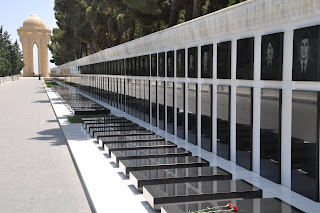
After a lunch stop (more Turkish doner), I went up and out away from the Old City, and went to see Martyr's Alley, a former park that was transformed into a memorial. It is now a memorial and a graveyeard for the people of Baku massacred by the Red Army on January 20, 1990. There is a small mosque, a flame to remember the victims, and tombs made out of black marble much like the Vietnam War Memorial in Washington DC. It is quite a moving place, and it also offers great views over the rest of the city.


I then walked around the outskirts of the Old City, exploring some more of the recent developments and architectural styles. Then I finished walking around by some of "Downtown" and around the sea, and then by the park where I live. There a shy little boy decided he really wanted his picture taken, so I happily obliged. Overall a fun and productive day.


Thursday, June 10, 2010

Ali and Nino

So I recently finished the book Ali and Nino written under the pen name Kurban Said. It is a somewhat cheesy love story of two young teens, but it is a fascinating look at the wide variety of ethnicities and cultures present here in the Caucasus. The novel is set during the time of WWI, and is the story of a young Azeri boy who falls in love with a beautiful young Georgian girl.

It tells the story both of Ali's Muslim faith and Nino's Christian upbringing, and it even shows some of the historic tensions between the people of Azerbaijan and Armenia. I would recommend the book for those interested in the various cultures of this part of the world, or anyone who happens to also be a hopeless romantic.